Monday, July 13, 2015

The Mighty Nile River

There is a saying in Egypt that if you drink from the Nile River, you will return.  Egypt is a very special place that I have always been drawn to return to, so maybe there is a little truth in it.  

The Nile river has sustained life for Egyptians since ancient times, over 7,000 years ago.  Today, the majority of people in Egypt, an estimate 95%, still live along the Nile River Valley. 

One of the best ways to see the Nile River Valley is to take a 4 night cruise down the Nile from Luxor to Aswan. The further you go South on the Nile, away from the pollution of Cairo, the more beautiful it is.  You can see farms along the way and small villages too.  Many ancient sites were built along the Nile, so the cruise will stop along the way so you can visit various temples and tombs. I was lucky enough to be able to experience this last week and below I'm going to share with you some of the wonderful things that I saw along the way.

This is a felucca boat.  If you look closely, you can see a man that is climbing to the top to fix the sail.


Relaxing on a felucca boat along the Nile. 

This is our Egyptologist guide George. He had to help the captain steer the ship while he was doing something up front.


It was a hot day; about 106 degrees.  There were boys and men swimming along the Nile here, right outside of a Mc Donald's.

The beautiful Nile River Valley

Outside the Temple of Karnak. They are working on a project now that will be a walking path, of over 1,000 statues they discovered underground, between the Karnak and Luxor temples to once again unite them both together like they were in ancient times.  The path will be almost two miles long between the two temples. This is an 11 million dollar project that started in 2004, and they are still working on it. There were homes in between, but the government had to help relocate those people so that they could excavate and work on this project.

 Luxor has had a few names since ancient times, but the one most recognized is Thebes.  The name changed to Luxor when the Arabs took over the area and it means 'the palaces.' The most impressive sights at the Karnak Temple are the massive pillars/columns inside and the obelisks.

The Luxor Temple
Me standing under a statue of Ramses II, also known as Ramses the Great. He ruled for over 67 years and is believed to be the Pharaoh referenced in the Exodus story from the Bible.  This statue is made out of solid granite stone.
Queen Hatsheput's Temple is also in Luxor.  She was the first female Pharaoh  and the only one after was the famous Cleopatra VII. You can find her mummy in the Cairo Museum; they just discovered it in  2007.  Here is a link  all about it http://www.theguardian.com/world/2007/jun/27/egypt.science
Look at the color that still remains inside Queen Hatsheput's Temple after about 3,500 years.
Just on the back side of Queen Hatsheput's temple is the Valley of the Kings and not far from there is the Valley of the Queens.  In the Old Dynasty they built pyramids to house the Pharaohs, but it was too obvious for grave robbers to find. So, they started to build tombs underground in a secret location so that the mummies and their treasures would be safe for eternity. Unfortunately, the people who helped dig and build the tombs ended up being the grave robbers. So far, the only untouched tomb found in the Valley of the Kings was Tutankhamen's which was discovered in 1922 by Howard Carter.  That is the reason he is so famous, not because he was one of the greatest Pharaohs to rule Egypt.
This photo was taken inside one of the Tombs in the Valley of the Queens. Look at all of the color still there after well over 3,000 years!

We passed by this old fashioned boat and it is where the setting for Agatha Christie's book Death on the Nile took place. The boat is called the 'Sudan' and it is one of the only steamboats left running on the Nile.


Sunrise
Sunrise
The deck of the boat was the perfect place to have a cup of tea, enjoy the view and  write in the travel journal.


Temple at Dendara; dedicated to the goddess Hathor. Hathor was the goddess of love and beauty; she is the Greek equivalent to Aphrodite.


The ceilings of tombs have the most color remaining since they do not get as much sunlight.

You will see many fishermen along the Nile River. Most of them use nets like the men seen in this picture.

A village and farm along the Nile River.


The Temple of Edfu.  This temple was dedicated to the ancient Egyptian god Horus.
Horus is one of the major gods in the ancient Egyptian Religion.  He is seen as either a falcoln, like the statue above, or as a man with a falcon's head.  Here is some more information on the story of Horus  http://www.touregypt.net/featurestories/horus.htm
Inside the temple, there are many cut out windows in the ceiling to let light in.

These fisherman along the Nile are using poles to catch their dinner.
Another pair of fisherman using a net.

Arriving a the Temple of Kom Ombo.  


This temple has two halves, one for good and the other for evil.  The good side is the story of the ancient Egytian god Horus and the evil side is the story of his uncle Set. In the myth, Set kills Osiris, Horus' father, for power.  Later, Horus seeks revenge and good overcomes evil. 


The Temple of Kom Ombo as the sun is starting to set.

It was an Egyptian themed galabaya party on the boat one evening. We are pictured here with another family that was there from NYC.

This is an Egyptian Whirling Dervish.  Their history is from the religion of Sufism.  Here is a video link of one so that you can see one in action :

Here is a link that explains more about Sufism  http://www.patheos.com/Library/Sufism.html
There was an Egyptian Belly dancer on the boat too and she had the most amazing live band music.  Today you mostly just see belly dancers for tourists at hotels and on boats like this one.  You may also see them perform at an Egyptian wedding.  Also, some people take classes because it is  an excellent form of exercise. 
The crew from the boat showed us some traditional Egyptian dancing.

To travel to the Philae Temple, you need to take a boat to get there.

This was the captain of our motor boat; he was around 10 years old and did a great job!  

The Philae Temple is dedicated to the goddess Isis.  She is one of the main ancient Egyptian goddesses and you see her on the walls of many tombs and temples.  Here is a link with more information on Isis  http://www.ancientegyptonline.co.uk/isis.html


Philae Temple is located on an island in the middle of the Nile River.

Temple guard in the blue galabaya and cane.  Many people in Egypt wear a galabaya and it makes a lot of sense because it helps keep you cool, and more comfortable, in hot weather. 


Market in Aswan, Egypt.  We were there looking to buy spices and in my opinion,  the best roasted peanuts in the world!  The peanuts  get roasted by placing them in the sand and letting the sun do all the work. They are crunchy and delicious. I ended up purchasing four bags to bring home to America.


Spice shop in Aswan, Egypt which is also located along the Nile River.  It is in the South, and is only a few hours north of the country of Sudan.  Many people who live here are called Nubians and originate from this part of Egypt that was called Nubia in ancient times.


Picking out spices to take home. We ended up getting cardamom, cumin, peppercorns, nutmeg, hibiscus and anise. 

A beautiful ibis bird along the Nile River.  The ancient Egyptian god Thoth was an ibis and he was the scribe in the underworld who would record the results during the 'weighing of the heart ceremony.'  Here are more details in the belief of this ceremony  http://www.egyptian-scarabs.co.uk/weighing_of_the_heart.htm


Sunset along the Nile River. 
 I hope these pictures have inspired you to come travel along the Nile River someday. Who knows, if you drink from it, maybe you will also return one day too!


Thursday, July 2, 2015

Egyptian Food


Egytian food has it's own unique dishes, but overall it has many similarities with other Mediterranean and Middle Eastern Countries.
Some of the best food you will find in Egypt is in someone's home.  Many Egyptians are welcoming and will invite you to their house for a meal.  When I first traveled to Egypt, an Egyptian family that our group had just met, invited us right away to their house for dinner.The family did not have a lot of money; they lived in a very small apartment, and owned very little, but they were rich in ways that money can never buy. When it was time for dinner, they laid a large sheet down on the ground in the middle of their main room.  The mother and children brought out the bowls of food from the kitchen and we all sat in a circle and ate.  I do not remember everything that we ate, but I definitely remember chicken, rice and I believe okra.  Middle  and upper class families eat at a table like we do in the United States.
It is a great cultural experience, no matter what part of the world you travel to, to have a home cooked meal in someones house.  You learn so much about the way people live.

Here are a few of some popular foods and drinks in Egypt:

 Kushari: This is one of my favorite Egyptian dishes.  Last summer we tried making it at home. It is not difficult to make, but it is time consuming since there are so many things you need to cook that go into it.  Kushari is considered to be the Egyptian national dish, it consists of pasta, rice, lentil beans, garlic, chickpeas, crispy caramelized onions, with a slightly spicy tomato sauce on top. Kusari is even better when you pour a little vinegar on top of it all. It has been a popular lunch item in  Egypt for over 100 years because it is delicious, filling and very inexpensive.
 Interestingly enough, Kushari’s origins are not Egyptian at all, in fact it was a dish brought in by the British army in Egypt in the 19th century: the pasta was imported from Italy, the tomatoes are from Latin America and the rice from Asia, however the idea to mix them all together in one extremely delicious and vegetarian dish was conceived in Egypt.
Kushari; this photo was taken from a restaurant called "Cairo Kitchen" which serves homemade style foods. It was yummy!

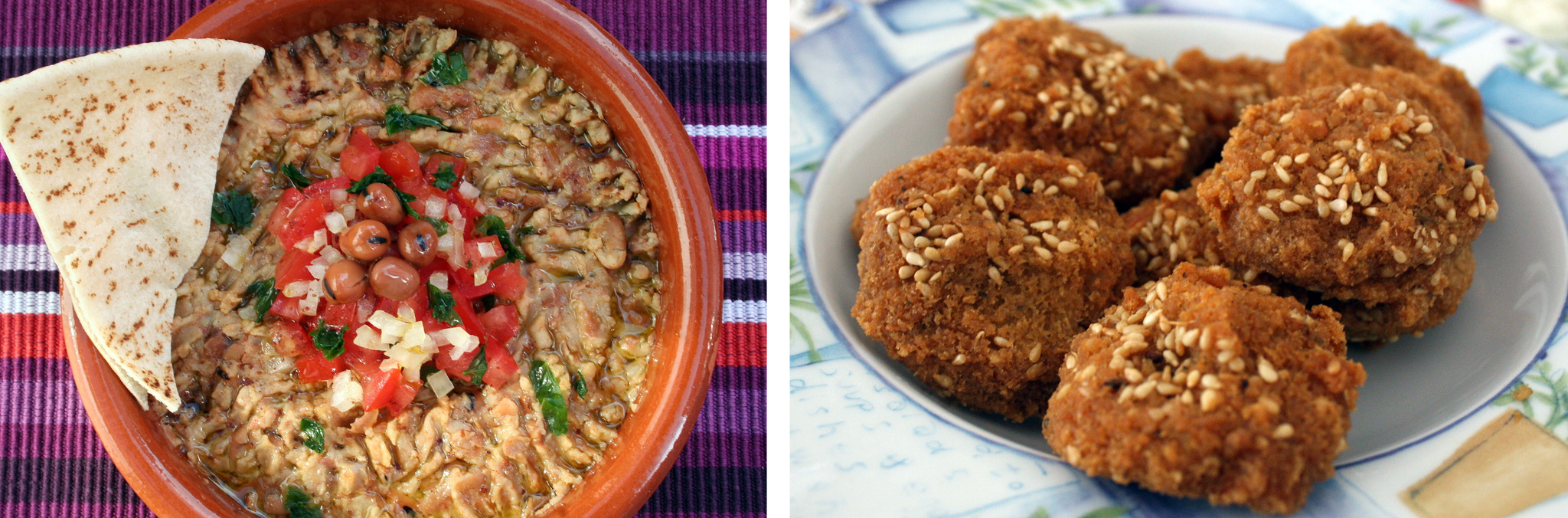
Ful and Tamiya (falafel)

Ful is of the common staple foods in Egypt, it consists of fava beans served with oil, garlic and lemon juice. Ful Medames can be traced to Pharaonic roots, and quantities have been found in the Twelfth dynasty. The word “Medames” is Coptic for “buried” which refers to the way it was initially cooked: in a pot buried in hot coal or sand. Ful Medames can be served with many embellishments such as butter, tomato sauce, tahini, fried or boiled eggs and pastrami. However, the most traditional method is to eat it plain and salted in an Egyptian bread bun.

You may have heard of tamaya before; in the United States and various other countries, we call it falafel.  Falafel are delicious, deep fried balls of chickpea and herbs usually served with salad, or in a sandwich with hummus and pita bread.

If you’re in Egypt and you ask for falafel, more than likely what you will actually received are Tamiya, the superior Egyptian version of the classic Middle Eastern dish. The recipe for Tamiya – or the Egyptian falafel – is similar to that of traditional falafel, however instead of using chickpea, they use mashed white broad beans (fava beans) instead.

Ful and Tamiya
 Mahshi - (stuffed vegetables) A healthy vegetarian meal made by stuffing vegetables such as cabbage leaves, tomatoes, green peppers, grape leaves and eggplants with rice seasoned with herbs and spices. This is then placed in a pot and topped with tomato sauce and lemon.
Mashi and rice; the dish, from my dinner above, has small eggplants (aubergines), green peppers and zucchini. 
Molokhia (or Molokheyyah) - A soup made from finely chopped mallow leaves mixed with ground coriander and garlic. It is a staple part of Egyptian food though is normally only eaten at home. Sometimes chicken, lamb or rabbit is added to this greenish soup.

Molokhia is not my favorite Egyptian dish because of the mucus like texture that it has. 
 Shawarma - This popular Middle Eastern sandwich is made from shaved goat, chicken, lamb, beef, or turkey. It is rolled in pita bread and tahini sauce.
This is what the shawarma meat looks like before it is sliced of and put in pita bread for a sandwich.
Kofta - Sometimes called Kefta, these are spiced meatballs (looking more like small sausages than balls) often served on a skewer.

Image result for baba ganoush
Baba Ghanoush
Baba Ghanoush - Made from grilled eggplant that is peeled then mashed and mixed with tahini (sesame seed paste), lemon juice, salt, pepper, parsley, cumin and dressed with olive oil. This dip has a smoky flavor and is best served with pita bread.

Some Egyptian Desserts:

Baklava - Layers of flaky pastry filled with chopped nuts and honey syrup.

You can find baklava in many Mediterranean and Middle Eastern countries, but you can also find it in stores and restaurants in America.
Halawa - a popular confection in Egypt made from sesame paste. It is normally sold in blocks (by weight).  It is a bit too sweet for my taste.
When I was living in Egypt, my friend Christine and I were actually in a commercial for halawa and the product is in the picture below. They were looking for a diverse group of people to be in the commercial. We went to the studio, got make-up on, rehearsed the song in arabic and sang the jingle with a large group of people holding up the halawa product.  It was a fun experience, but I never did get to see the commercial on television.


Roz Be Laban - rice pudding with a hint of vanilla. This is my favorite Egyptian dessert, especially topped with pistachios or hazelnuts!
Image result for roz bil laban

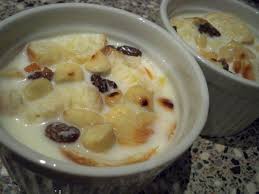
Umm Ali - Layers of bread soaked in milk with raisins and sometimes topped with nuts. It is served hot.

Some Drinks:

Karkaday is extremely popular, the locals say this hot drink calms the nerves. It is a red colored native drink made from dried hibiscus flowers, served either hot or cold.

Image result for karkaday
Sahlab  is made from crushed orchis mascula, sesame seeds, coconut, milk, sugar with nuts and raisins on the top of it. It is served hot; Coffee shops have really good ones.
Image result for sahlab

Hummus El Shams: This is a warm drink that is a little bit spicy.  It has garbanzo beans/hummus floating at the bottom. It is almost like having a meal or soup in a cup.
I was served this while visiting the Naguib Mafouz cafe in the Khan El Khalili Bazaar.

My favorite things to drink in Egypt are all of the fresh juices.  The two I love the most are mango and strawberry!
Ms. Fuller had the mango juice and Ms, Chambers and I had the strawberry. It was delicious!!!

I hope that gives you a sample of what some of the food and drinks are like here in Egypt.
If you were in Egypt, what would you most want to try?  Is there anything above that you have already had? If so, how did you like it?

Wednesday, July 1, 2015

Khan El Khalili


Khan El Khalili is a famous souk (bazaar) that dates all the way back to 1382 and is located in the Islamic district of Cairo.  When you are here you feel like you are truly transported back in time.  It is like a mini labyrinth inside and it's easy to get lost.  It is a place where some locals come and it is a favorite stop for  tourists to do some bargaining and shop for treasures.

Shop keepers are eager to make a deal with you and invite you into their stores.

Otto, Fuller, Chambers and Shop Keeper Hany

Many shop keepers will even offer you tea while you are looking around at the various items for sale. The best rule for bargaining is to negotiate for half of what they ask and then work back and forth until you have reached a deal.  No one will sell you something if they are not making money off of it, even if they tell you differently. For example, today Ms. Chambers wanted an alabaster candle holder. The man asked for 160 Egyptian Pounds, I countered back with 50 pounds (I decided to start with less than half) and by the time we were done bargaining, we agreed on 85 pounds.  It is a lot of fun to bargain for things and walk away feeling like you got a good deal and worked for it!
Alabaster candle holders
Copper and brass plates and decorations
The souk is full of countless other treasures for sale, but here are a few popular items:


Statues
Papyrus Paintings

Mother of Pearl Boxes


Spices

Silver (and gold) jewelry and various items
Perfume oils and bottles


Lanterns


All different types of beads


If you went to the Khan, what would you most want to purchase? Do you think it would be fun to bargain for items?  Have you been anywhere similar to this market or heard about something like it before?